Everton Independent Research Data
EVERTON FINED
July 1, 1906. The Liverpool Daily Post and Mercury
With regard to a complaint of the Lively Polly Club v. the Everton Club, the commission which was appointed found that Everton Club has been guilty of a breach of Rule 37, and recommended that the club be fined £2 for each offence and pay the expenses of the witnesses. The recommendation were agreed to.
THE NEW LIVERPOOL COTTON EXCHANGE
Liverpool Daily Post and Mercury - Monday 02 July 1906
DESCRIPTION OF THE BUILDING
Rapid progress towards completion is being made with the new Liverpool Cotton Exchange in Oldhall-street. The accompanying picture conveys a good idea of what a magnificent pile of buildings the structure will represent. The designs from which the Exchange has been erected were those of Messrs. Huon Mater, and Simon, architects, of Century-buildings, North John Street, Liverpool. On all hands, alike by residents and visitors from America and the Continent, the building is proclaimed as one of the handsomest in the world connected with commercial operations. It certainly, besides being eminently well adapted to the vast business interests it is intended to serve will be a splendid addition to the grand range of beautifulpublic buildings of which Liverpool cannow boast so many. The Exchange is bounded on its four respective sides by Oldhall-street, Ormonde-street, Edmund street, and Bixteth-street, the site being a central and commanding one in every respect. It is only about twelve months ago since the building was commenced, and so wonderfully quickly have the operations of erection been carried on that it is quite expected this year will mark its completion. It is calculated that the aggregate cost of the structure will reach from £190,000 to £200,000. Parenthetically it may be stated, as a matter upon which the Building Committee and the Association have reason to be well pleased, that the whole of the numerous offices provided in the Exchange have already been bespoken by cotton brokers. These offices will have entrances from the four surrounding streets named.
A pillared portico gives access to the rooms Exchange proper, which is an imposingand handsome hall surrounded by a twostoreyed colonnade formed with polishedgranite columns, having marble bases capitals, and balustrades. The ceiling will be panelled and carved in fibrous plaster with large curved counter light, composed of moulded wood and ornamental glazing completely protected by an outer roof of glass. Around this interior of the majestic fabric will be conveniently arranged the private and public telephones, and the post, telegraph, and cable rooms. Special “tape” machines will be installed. A very elaborate system of intercommunicating telephones will be introduced as well as numerous electric clocks all “timed” and automatically regulated to synchronise with the “hour o’ day” as per the Exchange, in order to obviate confusion and conflicts of opinion in the transaction of business. Immediately off the Exchange will be the members’ private reading and smoking rooms which will also be available for the general meetings of the Association. The Arbitration and Appeal rooms will be located on the top floor, and will comprise two spacious apartments with the finest light conceivable. The remaining office accommodation such as Clearing House, Clearing-room, bank, etc will be situated on the first floor, as will also the Beard secretary’s, and committee rooms. A club has been formed in connection with the Exchange, and the room for this will be found on the top floor, with access on to roof terraces and gardens, which will command fine views of the river and the Welsh hills. There will be excellent services of lifts both for passengers and goods, which will materially add to the convenience and facilities of the building. In the basement a recherche café will be established for the use of members and the general public. In addition to the lower portico of the Exchange, two open balconies will be found on the first and second floors, so that members can, in the sultry weather, discuss and transact their business practically in the open air. The structure is of fine Portland stone, and considerably enhances the character of the neighbourhood in so far as the amenities of its buildings are concerned. The impressive row of Ionic fluted pillars, and the generally dignified and noble treatment of the Oldhall-street façade, impart an appearance of importance and grandeur of the building worthy of the famous and honourable traditions associated with the Liverpool Cotton Exchange.
A limited number of Proofs on art vellum of Mr. Weirter’s drawing of the new Cotton Exchange may be had on Wednesday at the “Post” and “Echo” offices. Price 6d each, or by post 7d.

BEE’S NOTES
Liverpool Echo - Monday 02 July 1906
O’Hagan, the ex-Everton player and Irish International inside left, has now signed on for Middlesbrough.
Irish International Appointed Secretary Middlesbrough F.C.
Irish News and Belfast Morning News - Tuesday 03 July 1906
Mr. C. O’Hagan, late of Tottenham Hotspur, the well-known Irish international forward, has been appointed secretary of Middlesbrough, the English League Club to which was recently transferred from Everton. Mr. O’Hagan is a native of Buncrana, Comity Donegal. His first experience of senior football being with Derry Celtic against Belfast Celtic, at Celtic Park, some five years ago. While at St. Xavier’s College, Liverpool, he attracted Everton’s attention, and assisted the reserves. Afterwards went South, Tottenham whom he assisted a couple of seasons. In addition to his new duties he will take the field, when required. It is pleasing to note an Irishman securing such an important appointment in first-class football.
L.R. ROOSE ON THE ART OF KEEPING A GOOD GOAL
Liverpool Echo - Wednesday 04 July 1906
Bee
When complete the seven volumes of “Association Football” will be prised by all who have taken them from the Caxton Publishing Company, and many a pleasant memory will be brought to mind when perusing Vol III in particular. Part II has lengthy references to the two Liverpool clubs; the latest issue deals with more about Lancashiremen and matters, and Messrs W. Pickford and Jas Gibson are to be congratulated on the excellence of their writing while the pictorial portions of the volume are numerous and distinctly reproduced. Mr. Gibson is a football journalist under the nom de guerre of “Rover,” and one of the book’s pictures shows Mr. James Catton interviewing Steve Bloomer. Mr. Catton is editor of the best athletic paper, and is, as “Tityrus,” known all over the country as a brilliant writer. Only once did I ever dispute his criticism. I class him the greatest writer of the day on football. Some day I may tell Mr. Catton’s daily day. He is a remarkable and remarkably little man, and the amount of work he gets through is stupendous. Imagine yourself with eight columns of en passant to fill with chatty, logical deduction on cricket and football, and the Lancashire cricketers to be followed each match and a column to be wired to an evening paper, and another column on the same subject; and a column or more on Footballania for Monday, and a column and a half or review of the Lancashire match for Monday’s issue, and-and a number of other “ands.” Yet this is what this editor moves each week, and never does he get stale. Mr. Pickford, in Vol. III, deals with the referee, past, present and future, and then London football growth is commented upon. The North Country clubs’ histories are told and so are the Manchester and Bury clubs.
Leigh Richmond Roose, the inimitable on the art of goalkeeping says;-
How far is a goalkeeper born-how far made? An experience of the game leads one to the belief that to a great extent a goalkeeper is born, not made. Almost all the best goalkeepers which one is sure to call to mind have possessed some inherent gift which marked them out as natural players, and have taken to that position as readily as a duckling takes to water, and, if followed from their early careers, it would be found that these natural players ranked as “class” man almost from their first games. There is no particular style in class. It has one great style. The genius is there, and genius will out in goalkeeping as in other accomplishments. However, it is only possible to attain a certain level of this valuable but elusive entity, and born footballers of the first water are not content to allow their talents to take the place of the polish which only really steady work can produce. A goalkeeper, therefore, must have a natural gift of some kind. A goalkeeper’s duties are 90 per cent, defensive, and the only occasions on which he can be said to compose part of the attack are when his co-defenders are playing rather far forward, or some distance away, and the ball has been over-kicked towards the goal by one of his opponents and on other similar minor occasions. A forward may shoot wide of the open goal with impunity; a goalkeeper, on the other hand, cannot be allowed to blunder, otherwise the spectators in the vicinity of his goal-although very generous in their appreciation of a good piece of work-are very severe on a failure. A tall man able to get down to low shots is certainly preferable to a short one, for he can reach shots no little man can get near, and if his bigness in stature is combined with weight he will find there are occasions on which his height and weight will prove of great advantage to him; yet he should not come under Dryden’s description, “Brawn without brain is time.” He should possess quickness of eye and hand, activity and agility, and be as light on his feet as a dancing master. It’s not much use for a man who can only move “once in about two months” trying to defend a space twenty-four feet wide and eight feet high against shots coming from all possible directions. The easy confidence displayed by a custodian in taking shots from all angles and positions is only equalled by the holy calm shown by the man who has just bowed his mother—in-law out of the family porch. How a goalkeeper goes into the field of play has a good deal to do with how he feels, for, after the fashion of staff officers and correspondents in warfare, those who have little to do but to look on have the most trying time of it, especially if there is any “bleaching” in them. It is the waiting and watching when you see your forwards and backs being slowly but surely driven in on you that will make a man unsteady at the critical moment.
Roose in the early stages of games could generally be relied on to take goal kicks with strength, but after the interval he tired somewhat, and a throw-in invariable resulted. Roose gives it as his opinion that the custodian where possible should take a free kick himself so as to relieve his backs and give them a breathing interval. I agree with this, and that is why I deprecated some of the local half-backs who passed back to the back for no apparent reason. Photos of the Football Association Council are accompanied by biographical notes. Of Mr. J. McKenna, of the Liverpool Club, the writers point out that he is one of the latest recruits, and that it is as an organised and worker that he has made his mark in the game. His first connection with football was in 1885, when he was elected chairman of a Volunteer club in this city. He then joined Everton, and after the split in 1892 he helped to form the Liverpool organisation, and in 1893-4-5 was its hon. secretary. Since 1900 he has been the vice-chairman of the club. For twenty-five years Mr. C.J. Hughes was hon secretary of the Cheshire F.A., and he is aptly described as cheery, brisk, bright, and resilient. A trap accident and a broken ankle curtailed Mr. Hughes’s playing career. He can claim to have referred finals of all cups, acted in international matches, shot with the Volunteers, rowed in club races, played for the Northwich Cricket Club, competed in foot races, and later was handicapper, and has held numerous public positions. Another “life” concerns Mr. R. E. Lythgoe, who goal for the Druids in their first match. He was their secretary in 1874. “Bobby” helped to form the Welsh Association, and when he came to Liverpool as a missionary he put before the Mersey heathens a proposed to bind the Birkenhead and Liverpool Clubs together, hence the birth of the Bootle Club, which I often regret is not continued to this day. For twenty-four years Mr. Lythgoe has been the hon. secretary of the Liverpool Association. Full-page photos are shown of Messrs. J.J. Bentley, Kirwan, John Lewis, Alcock, Crump, and others of note in their respective sphere; and in the smaller phots there surely has been an error when the United’s left is shown to be busy, and the players’ names given are Best and Lipsham. It would have been best had they read “Glover and Lipsham.” Still, this is a minor matter, and does not detract from the admirable book, which commands success.
ENGLISH CUP FINAL FATALITY.
Liverpool Evening Express - Saturday 07 July 1906
TO THE EDITOR OF TEE EVENING EXPRESS.
Sir —May I ask you to allow me to express my sincere thanks to Superintendent Cross (Seaforth Police) and the Everton Football Committee, for the most kind and humane treatment they have shown to me. In April last my son witnessed the English Cupfootball match at London, and when returning fromEuston Railway Station, he was accidently pushed between the platform and train, and received terrible injuries. He was conveyed to Guy's Hospital, where after every kind attention, he died. Upon the fact being made known to me, I applied to Superintendent Cross for information, and that officer very willingly exerted himself to ascertain particulars for me. The Everton Football Committee also organised a collection on my behalf, through which I received a nice sum, and in fact the great kindness shown to me by Mr. Cross and the Everton Football Committee was the means of alleviating my trouble. MARGARET FOLEY, 30, Conway-street, Seaforth, July 6, 1906.

LIVERPOOL POLICE SPORTS
Liverpool Evening Express - Saturday 07 July 1906
Results of the Competitions.
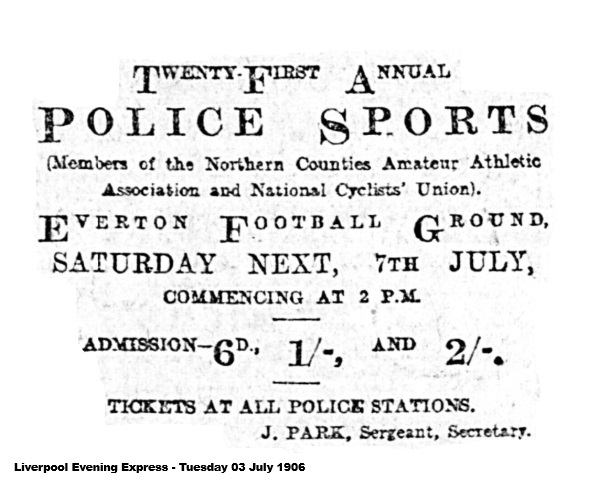
The twenty-first athletic festival promoted by the Liverpool Police Athletic Society was held this afternoon on the Everton football ground at Goodison-park. Favoured by glorious weather, the evert proved most successful, and there was a large attendance of spectators who enjoyed sport of an interesting character. Music was supplied during the afternoon by the Police Band under Mr. Crawley.
The entries were well up to those of previous years and keen contests were seen in many of the events. The Head-constable (Mr. Leonard Dunning) gave a garden party in connection with the affair, and there was a numerous gathering of guests. The Lord Mayor (Alderman J. Ball) and the Lady Mayoress attended during the afternoon.
Results; 100 Yards Flat, open to members of any police force.— Winners of heat,: A. Brickley (11), J. Andrews (7 ½ ), M. Carroll (7 ½ ). C. C. Coward (7), G. Parker (3), and H Stephens (11)
100 Yards Flat Handicap, for members' and pensioners' sons over 7 and under 15.—Winners of heats: J. Colton (14), D. A. Emberton (8), R, M. Stephens (16), F. Mays (9), R. Donaldson (28).
Mile Bicycle Handicap (open to members of any police force).—First heat: 1, A. Noble, Salford, 140; 2, G. J. Stephenson, Liverpool, 105. Second heat: 1, H. Waters, Hull, 100; 2, E. Dobson, Hall. 95.
100 Yards Flat Handicap (open to police).-I, H. Stephens, Liverpool, 11; 2, P. ,Stephens, 7 ½ ; 3, G. Parker, Hull, 3; 4, M. Carroll, Liverpool, 7 ½ .
100 Yards Flat Handicap (members' sons).—Final: 1, R. N. Stephens, 16; 2, J. Culton, 14; 3, E. A. Emberton, 8; 4, F. Mayor, 3; 5, R. Donaldson., 28.
100 Yards Flat (open).—Winners of heats: R. Spencer, Preston. H., 9 ¾ ; T. A. Crellin. Sefton H, 8; P. T. Parry, Shotton, 7; A. E. N. Parry, L.H. and A.C., 7; R. 'Molyneux, L.H. and A.C.. 5 ½ ; H. J. Trantom, Pembroke H 7 ¾ ;H. N. Norris, Aintree, 8 ¾ ; J. Barker, Pembroke H, 8 ¼ ; S. 0. Hardy, Sutton-in-Ashfield. 9 ½ ; W. W. Challoner, Prescot A-C.. 7 ¾ ; W. R. Williams, Sefton H 8 ¾
220 Yards Flat.(members).—First heat: 1, J. Ashton; 2, J. Todd; 3. R. Lund. Second heat: 1, J. H. Ingram: 2, S. E. Stephenson; 3, C. C. Coward. Third heat: 1,McMay; 2, G. S. Johnson; 3, R. Scott.
Mile Bicycle Handicap (open to police).—Final: 1, H. Waters Hull, 100 yards; 2. E. Dobson. Hull. 95: 3, A. Noble, Southport, 140; 4. G. J. Stevenson, L.P.A.S., 105.
100 Yards Flat Handicap members and pensioners' daughters over 7 and under 15).—Winners of heats: W. Johnson (1 yard), E. R. Robinson (20), E. Johnson (19), A. M. Ford (2), H. M. Seaton (23)
100 Yards Flair, Race (open), Second Round .—First heat.: R. Spencer 1, H. J. Trantom 2. Second heat.: F. 0. Hardy 1, W. R. Williams 2. Mile Bicycle Race Handicap (open).—Winners of heats F. O. Hardy, 1, W.R. Williams 2
Mile Bicycle Race Handicap (open).- Winners of heats; H. Chilton, Hull, 170; N.E. Taylor, Aigburth, 175; V. Cross, Birkenhead, 175
Tug-of-war.- Liverpool Police beat Hull City Police; Seaforth P.S.A beat L. and N.W Railway, Canada Dock.

TOWER BUILDING LIVERPOOL
Liverpool Daily Post and Mercury- Friday 13 July 1906
VANISHING LIVERPOOL
With the close of the current year, the tenants of Tower-buildings, which stand betweenSt.Nicholas’s Church and Water-street, are to vacate their offices pending the carrying out, by private enterprise, of a rebuilding scheme which is to produce a pile of more important proportions. Hence our artist has betimes sketched a bit of familiar vanishing Liverpool. Tower - buildings date from 1856, having served as offices for many shipping and other firms during the last half a century. Owing to the prominence of the tower, the storm signals have been displayed from its summit. Many are the historic associations. During first quarter of the century the site of the Tower-buildings was occupied with a grim-looking. castellated structure, the “Tower” of Liverpool in the olden times the fortalice of the Earls of Derby, but no records exist to cast any light on the period of its first erection, though its after-history is entwined with the fortunes of the Stanleys of Knowsley. For many years the Tower of Liverpool was the seaside residence and embarkation place for the of Man and Ireland of the Derby family. In the south wall of the inner quadrangle a stone tablet (which will doubtless perpetuated) is inserted with the following inscription;-
Has Aedes
Situm olim castelli
Comitum de Derby
Denuo construxit
Negotiis, pacisque artibus fovendis
Dedicavit
Jos Bailey Eq. Aur
Anno Salutis MDCCCLVII
Architecto, J. A. Picton.
It is to Sir James Picton, architect and Historian, we are indebted for the above outline, Of the importance to the marine interest of Tower-buildings to-day it will suffice to state that over seventy firms mostly associated with marine business, have their offices in the block together with the Mercantile Marine Service Association, the Aged Merchant Seamen and Widows’ Fund, Homes Liverpool Homes for Aged Mariners, Liverpool Seamen's Pension Fand, School Ship Conway, “Margaret Ismay ” Widows Fund, and St Andrew's Waterside Church for Sailors, Fishermen end Emigrants.
GOREE PIAZZAS
A little to the south of Tower-buildings run the two blocks of warehouses known as the Goree Piazzas, which occupy the site allocated to the original warehouses erected in 1793, their appearance in an engraving dated1772 being an anachronism as the first warehouses then existed only on paper. The name Goree which has been retained, wasbestowed because of the prosperity if its African trade in Liverpool, notably in connection with the imports received from the Goree island entrepot, a bare basaltic rock about a mile off Cape Verde, once in Dutch hands, but now part of French Senegal. In Mid-September, 1802, the warehouses were destroyed by fire, the damage being £323,000, while a local insurance company, called the “St. George’s, formed but three months before, succumbed. The fire, which was locally without precedent, smouldered for three months. Soon rebuilt, the warehouse now a century old, have since enjoyed almost an immunity from serious conflagration, save that on February 17, 1840, damage by fire to the extent of £50,000 occurred in Back Goree. The old United States Consular office of Nathaniel Hawthorne was in the Goree, while in 1817 Washington Irving represented at No. 1 a firm of merchants associated with his family. It will be interesting to revive these recollections when the Goree Piazzas are actually scheduled for demolition. At present only two of the leases have fallen in to the Corporation which, however, is not renewing, so that the days of the Goree are slowly but steadily drawing to an end, and thus the unique warehouses really belong, like the Tower-buildings, to vanishing Liverpool.

NEW FOOTBALLER FOR DARWEN
Preston Herald - Saturday 14 July 1906
Edgar Chadwick, who last season captained Glossop team, on Wednesday, signed on for Darwen. The Glossop club was anxious to again secure his service, but Chadwick was desirous of joining a team nearer his own home. He commenced his career with Blackburn Olympic; but he won fame with Everton, when he was considered without equal in his position in the forward line.
THE CONLIN FIGURE
Liverpool Echo - Saturday 14 July 1906
Bee
A Bradford correspondent telegraphs that the fee paid by Manchester City for the transfer of Conlin is £1,000, which is equivalent to the fee paid by Middlesbrough for Common. The Bradford club had previously refused an offer of £5000 from Aston Villa and £800 from Everton for Conlin since he got his international cap, but they have now accepted the thousand pounds.
EDGAR CHADWICK
Athletic News - Monday 16 July 1906
The last link of a famous quintette of Association forward viz., Latta, Brady, Geary, Chadwick, and Milward, is making a good fight against Anno Domini. Edgar Chadwick left Blackburn Rovers to join Everton and secure International honours at the formation of the League in 1888, and after a long stay with Everton he has gone the rounds of the country and in addition acted as coach on the Continent. Now he has signed for Darwen, and the engagement should be a mutual one.
Lewis
The grieved ones were somewhat mollified when it was announced that Lewis, the Somerset cricketer, and of Sunderland, Sheffield United and Everton fame, had been engaged with Leicester Fosse.
DEATH OF A WELL-KNOWN FOOTBALLER
Liverpool Daily Post and Mercury- Thursday 19 July 1906
The death occurred at Blackpool on Tuesday of Sam McClure, the well-known footballer, and a member of the Blackburn Rovers team, from an abscess in the ear affecting the brain. McClure, who was centre half back and a brilliant player was a deadly shot at long range, and has scored many a goal. He was a sprint runner, and won several handicaps. Born in Workington, he played with the Black Diamond Club of that town before joining the Rovers. He was twenty-eight years old.
BEE’S NOTES
Liverpool Echo - Thursday 19 July 1906
GEORGE MOLYNEUX’S NEW CLUB
All is peace at Goodison Park. Only Elliott’s black cat may be seen during office hours, the officials and players having gone on holiday.
West Ham, George Kitchen and Wildman will be seen next season, has been transferred to Southend United, the new professional club, and George Molyneux, ex-Everton, Southampton and Portsmouth back has joined this club.
EVERTON FINED
Lancashire Evening Post - Saturday 21 July 1906
With regard to a complaint of the Lively Polly Club v. the Everton Club, the commission which was appointed found that the Club had been guilty of breach of Rule 37, and recommended that the club be fined £2 for each offence, and pay the expenses of witnesses.—the recommendations were agreed to.
EVERTON FOOTBALLERS PACKING UP THEIR LUGGAGE
Liverpool Echo - Saturday 21 July 1906
Bee
The Everton players and officials are now packing up and ending their vacation. Mr. Secretary Cuff returns from Abersoch to-night, and the players are due to report themselves on Tuesday, August 7 and serious training will commence on the following day. Most of the players have been out of town. Black, Young. Donnachie, and Donaldson are in Scotland, Abbott in North Wales, Settle at West Horton, Scott at Belfast, Hill at Southampton, Chadwick at Blackburn, and Wright in Kent.
EVERTON NEWS
Dundee Evening Telegraph - Wednesday 25 July 1906
In recognition of the performance of the Liverpool players in winning the League Championship the Liverpool Directors have sent Mr. Tom Watson, the secretary, and the players for a week or ten days' trip to Paris. In similar fashion Everton took their players to the Derby, and afterwards to Brighton.
BEE’S NOTES
Liverpool Echo - Monday 30 July 1906
The Everton players are getting ready to trot out on the greensward at Goodison which looks in perfect order, and reflects great credit on the turf-keepers. The directors have been holding their meetings to get all in readiness for the practice matches which are to be held on August 18 and 25. Possibly the latter date nay be re-arranged, and in that case August 27 would be the date chosen. They hope to make a good sum for charity out of these matches and the charge for admission will be 2d and 3d, boys being admitted at a penny. The season tickets are in hand, and nearly ready, and an important item for the season-ticket-holders who visit the shilling stand is that they will enter from the Gwladys-street side of the ground instead of, as formerly, the end nearest Stanley-Park. Mr. John Fare is superintending Anfield, in the absence of other Liverpool officials.
July 1906